Employee Handbook Updates Pennsylvania Employers Need in 2026

Are you managing employees in 2026? Then say goodbye to paper employee handbooks.

When was the last time you went digging through your old files for your employee handbook? And even if you found it, would anyone actually read it?

Today’s workforce is accustomed to information that is quick, accessible, and engaging. Few employees want to read through dozens of pages of dense text in black-and-white, Times New Roman font.

Instead, people absorb information better through visuals, short sections, and interactive formats such as videos. These methods have proven to be far more effective for helping people understand and comprehend information provided to them.

Most importantly, you want employees to actually read it. An informed employee who is aware of company policies and expectations will likely follow them.

With that in mind, here are important updates to consider as you revise your employee handbook this year.

 

business woman wearing headdress

The CROWN Act: New Pennsylvania Employment Law Effective January 2026

In Pennsylvania, effective January 24, 2026, the Pennsylvania Human Relations Act now prohibits discrimination based on hairstyles and head coverings under the new CROWN Act. This law expands the definition of “race” and “religious creed” to include traits historically associated with race and ethnicity, including hair texture, hairstyles, and head coverings.

For employers, this means workplace policies on grooming, dress codes, and appearance standards must be reviewed and updated now. Any grooming policy that has not been evaluated since this law took effect may expose your business to a discrimination claim under Pennsylvania law.

 

man using chatgpt at home for work purposes

AI and Technology Use Policies Are No Longer Optional

Five years ago, an AI use policy in an employee handbook would have been unusual. Today, not having one creates real risk for Pennsylvania employers. Artificial intelligence and other emerging technologies are becoming a part of our daily work. While AI can be a powerful productivity tool, it must be used responsibly.

Employers should clearly outline their expectations for technology and AI use in their handbook. AI tools may be used to assist with work product, but employees remain fully responsible for the accuracy and quality of anything they publish or submit.

Another important consideration for employers is that AI should never be the sole basis for employment decisions. This includes hiring, firing, discipline, promotion, and performance evaluation.

Finally, confidentiality is another major concern. Employees should be instructed to use only company-approved AI tools for legitimate business purposes and should never upload confidential or proprietary information to public or unapproved AI systems.

This is not a complete list. AI technology is evolving very quickly. Employers should remain vigilant and contact our office to discuss what other safeguards are vital in implementing AI use in the workplace.

 

 woman working from home

Persisting Remote Work Culture

Expectations around remote work continue to evolve. Even though it has been six years since the COVID-19 pandemic sent everyone home to work from their couches, many employers still do not know how to manage it effectively.

Some common WFH questions employers have include:

  • Should the employer pay for home internet service?
  • What about electricity or equipment used?
  • Is the employer responsible if the employee is injured while working from home?

While not every situation can be predicted, having a clear policy in place helps mitigate those uncertainties.

A clear policy helps answer these questions before they become disputes. At minimum, your remote work policy should address:

  • Defined work hours and availability expectations
  • Safety responsibilities for remote workspaces
  • Equipment and expense reimbursement
  • Monitoring and technology use
  • Remote work location changes
  • Expectations for professionalism in digital communications

group of workers sitting in a common area discussing the proposed non-compete ban

Common Missteps Pennsylvania Employers Still Make

Even if you are ahead of the game and feel like you have a handle on the concerns above, many employers still overlook key issues that are worth reiterating here.

At-Will Employment Language

Many handbooks simply state that employment with the company is “at-will.” Unfortunately, not all employees know what “at-will” means.

What is at-will employment in Pennsylvania?

At-will employment means that either the employer or the employee can end the employment relationship at any time, for any reason or no reason at all, as long as the reason is not illegal, such as discrimination or retaliation. There are some exceptions, including written employment contracts, union agreements, and certain public policy protections.

Including a succinct explanation of “at-will” can prevent future confusion about the nature of the employment relationship. Your handbook should clearly state that it is not an employment agreement or promise of continued employment.

Overcomplicating the Handbook

It is enticing for employers to include every policy they think they need to protect themselves. In many instances, these policies are overly dense with legal jargon and technical language, which make employees less likely to read them. Shorter sections and plain language can go a long way to help employees better understand company policies. In the end, edits or updates won’t matter if the employee does not bother to read the handbook.

A printed handbook that sits in a desk drawer or filing cabinet is unlikely to be consulted regularly. Digital versions are easier to distribute, search within, and update when needed.

Even better, employers can streamline their onboarding process by accompanying the handbook with short training videos or onboarding presentations that walk new employees through the most important policies.

If your dusty and dense handbook needs some updating, please feel free to reach out to our office for more information!

Work With an Employment Attorney Near You

Employee handbooks are one of the most practical tools a small business has, and one of the most commonly neglected. If your dusty and dense handbook hasn’t been reviewed since before the CROWN Act, before the rise of AI in the workplace, or before remote work became standard practice, it is time for an update.

High Swartz LLP is a full-service law firm serving Pennsylvania employers from offices in Norristown, Doylestown, Feasterville, and Wayne. Our employment attorneys help small businesses throughout Pennsylvania review, update, and implement compliant employee handbooks. Contact us to get started.

In Memoriam: David J. Brooman, Esq.

David passed away unexpectedly on March 7, 2026, at the age of 69.

We were saddened to learn of the recent passing of our partner, David J. Brooman, Esq., a respected voice in our offices and a dedicated advocate for his many clients. David brought decades of knowledge, practical judgment, and dedication to every client and matter he touched, from municipal governments to landmark partnerships that shaped communities across the region.

David was the kind of attorney who made difficult things manageable. His colleagues, both here at High Swartz LLP and throughout the profession, and the many clients he served were fortunate to have him in their corner. He will be greatly missed by everyone here, and our thoughts are with his wife Rosemary, his sons, and the entire Brooman family during this time.

Family and friends are invited to attend A funeral Mass will be held on Friday, March 20, 2026, at 10:00 AM at Our Lady Star of the Sea, “The Beach Chapel,” 554 E. Main St, Manasquan, NJ 08736, at 10:00 AM.

In lieu of flowers, donations may be made in David’s memory to the Support Center for Child Advocates, https://sccalaw.org/donate/.

David's obituary can be found here.

High Swartz Attorney Renata Pabisz Speaks on U.S. Immigration Enforcement and What Undocumented Immigrants Should Do Now

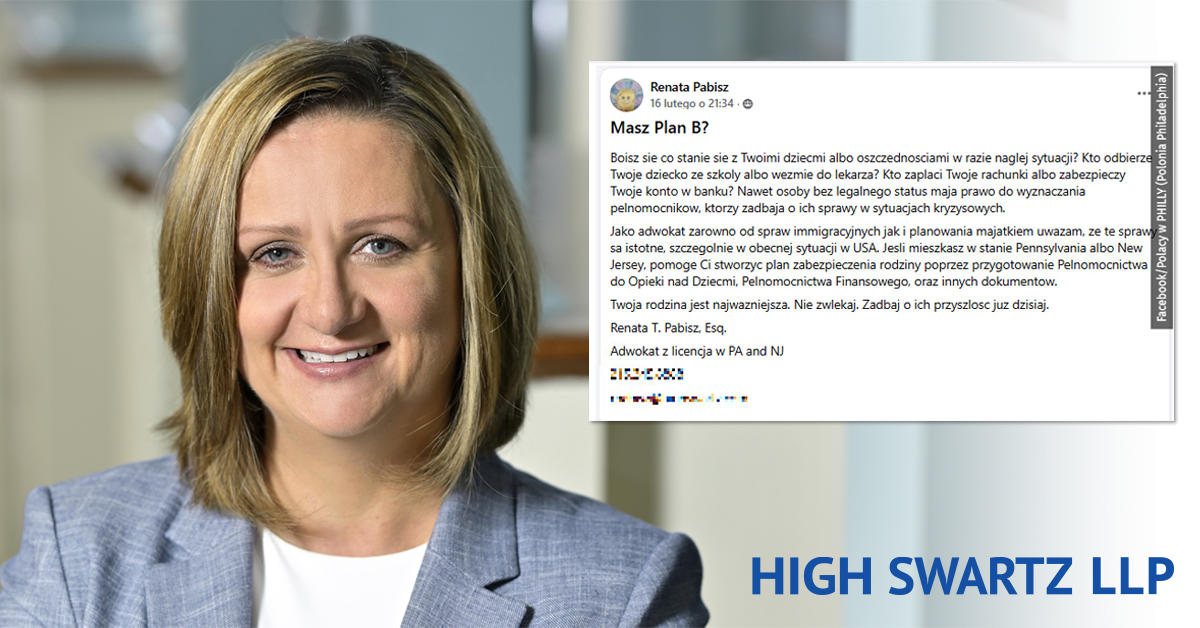
Attorney Renata Pabisz recently asked a timely immigration question on Facebook. A Polish journalist thought her insight should have a bigger audience.

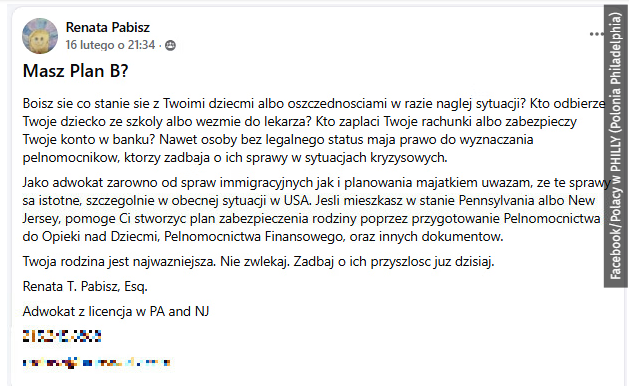
Written from her private social account and posted in Polish American Facebook groups, Renata’s question was simple: It asked, in Polish:

“If you are living here without legal status and ICE shows up tomorrow, do you have a plan B?”

facebook courtesy of Polacy de Philly

It wasn’t an ad. It was more about informing those that may be questioning their legal standing in today’s environment. It was the kind of practical legal guidance Renata gives her clients every day.

Journalist Tomasz Mateusiak, who writes for Onet.pl, saw the post and recognized the importance of the topic. According to Wikipedia, Onet.pl is one of the largest Polish-language news websites in the world, reaching 42 percent of internet users in Poland every week.


"Right after President Trump began his second term, there was a real panic," Renata told Onet. "I got calls, texts, and emails at all hours. People were afraid they would be deported from one hour to the next, not only from the Polish American community but from people of many nations living currently in the United States."


As of early 2026, DHS reported that over three million people have left the U.S., with more than 675,000 formal deportations and an estimated 2.2 million self-deportations since January 20, 2025.


"I have clients without settled immigration status who run businesses with millions of dollars in assets," she says. "If they are detained, everything they built can collapse overnight. This can be avoided with proper planning."


The resulting article, published March 4, 2026, drew significant readership across Poland and the Polish American community.

The Onet article can be read in Polish here. Translation to English can often be done by right-clicking the page and selecting the Translate option.

The main takeaway from Renata’s insight is this: Immigration laws are always changing. If you are living in the United States without legal status, the time to plan is before a crisis, not after.

The following are some of Renata’s suggestions that families can do now to protect themselves.

What can immigrants do now to protect themselves?

For undocumented immigrants, a durable power of attorney is one of the most important documents they can have. Under Pennsylvania law, a durable power of attorney permits a designated person to act on someone's behalf if they are detained or deported, without delay or court intervention.

A power of attorney, properly drafted by an estate planning attorney, can allow a designated person to access bank accounts, keep a business running, pay employees, fulfill contracts, sell property, and transfer assets to someone who has been deported.

But don’t delay. Waiting until after detention to get these documents in order can create significant complications. Foreign documents may require translation, notarization, an Apostille Certificate, and extended review by American financial institutions before sign off.

And that’s just for business sake. For parents, the stakes go beyond finances.


"It’s very important for parents to have someone they trust with formal authorization," Renata says. "In the worst-case scenario, a trusted relative with power of attorney can care for the child, or even send the child by plane to where their parent was deported."


A formally authorized caregiver can also pick a child up from school, authorize medical care, or assume temporary custody, all without social services involvement.

Are there options outside of deportation?

Not every ICE arrest results in immediate deportation. Most people are entitled to a hearing before an immigration judge.

A cancellation of removal could potentially be granted if the person can generally prove the following:

  • Living in the U.S. for ten or more years
  • No criminal record
  • Good moral character
  • Show that deportation would cause significant hardship to a qualified relative of a US citizen or a lawful permanent resident

Children of U.S. citizens over 21 may also be able to sponsor an undocumented parent for permanent residence in certain circumstances.

What about self-deportation?

For people who choose to leave voluntarily, the Trump administration's self-deportation program currently offers qualifying individuals a free flight home and a $2,600 stipend paid upon confirmation of departure. More information is available at dhs.gov/cbphome.

It’s important to consult with an immigration attorney to understand constantly changing immigration law and discuss your options. You can reach attorney Renata Pabisz at High Swartz LLP of suburban Philadelphia at (215) 345-8888 or email her at rpabisz@highswartz.com. Renata is licensed in NJ and PA. As an immigration attorney she practices nationwide and assists clients across the U.S.

About Renata Pabisz, Esq.

Renata is an immigration and estate planning attorney at High Swartz LLP in Doylestown, Pennsylvania. Born and raised near Nowy Sącz, Poland, she earned her law degree from Maria Curie-Skłodowska University before completing her legal education at Widener University School of Law. She has built her practice around helping individuals and families navigate complex immigration and Estate matters in Pennsylvania and beyond.


"Helping people with legal needs is my passion," Renata says. "I couldn't imagine any other career path, even if it meant practicing law in a foreign language."


The information above is for general informational purposes only and does not constitute legal advice. It should not be used as a substitute for consulting with an attorney.


Jak znaleźć polskojęzycznego adwokata w Twojej okolicy

Wiemy, że może być trudno znaleźć osobę, która będzie wspierać i rozumieć to, przez co przechodzisz. W naszej kancelarii zatrudniona jest polskojęzyczna prawniczka Renata T. Pabisz, która potrafi Cię wysłuchać. Mogą również skierować Cię do jednego z naszych prawników i wystąpić w Twoim imieniu.

High Swartz to firma prawnicza oferująca pełen zakres usług, założona w 1914 roku, obsługująca klientów w hrabstwach Montgomery, Bucks, Philadelphia County, Delaware Valley oraz w całej Pensylwanii z biur w Norristown, Doylestown i Wayne w Pensylwanii. Prawnicy High Swartz dokładają wszelkich starań, aby zapewnić swoim klientom doskonałe i opłacalne wsparcie na każdym etapie procesu prawnego.

High Swartz służy potrzebom przedsiębiorstw, gmin, jednostek rządowych, organizacji non-profit, rodzin i osób prywatnych. Ta firma oferująca pełen zakres usług, posiadająca biura w hrabstwach Bucks Delaware i Montgomery, zapewnia kompleksowe porady prawne i wsparcie osobom fizycznym i firmom każdej wielkości z szerokiego spektrum branż w Pensylwanii i stanach środkowoatlantyckich.

High Swartz LLP Welcomes Family Law Attorney Donna Marcus Braslow

High Swartz LLP is pleased to announce that Donna Marcus Braslow, Esq. has joined the firm. She will represent clients in family law matters, with a focus on divorce, custody, and support issues, from the firm’s offices in Norristown and Wayne, Pennsylvania.

A Philadelphia-area native who grew up in Abington, Braslow brings deep regional roots and longstanding professional ties to both Montgomery County and Philadelphia. She began her legal career as an Assistant District Attorney in Philadelphia. During her 14-year tenure with the Philadelphia District Attorney’s Office, she served in the Child Support Enforcement Unit, Drug Treatment Court, and the Public Nuisance Task Force, developing substantial courtroom experience and a practical understanding of the legal and personal challenges facing families.

Braslow has since built a respected family law practice representing clients throughout Montgomery County and the surrounding region. She is known for guiding clients through difficult and emotionally charged matters with compassion, clarity, and steady advocacy, and for earning clients’ trust during some of the most challenging periods of their lives.

“I’m thrilled to join High Swartz and to work with a firm that offers such strong resources and a deeply respected presence in the community,” said Braslow. “Family law clients are often coming to us during some of the most painful and uncertain times in their lives. I’m excited to be able to use the firm’s platform and support to help clients navigate divorce, custody disputes, and major life transitions with confidence, compassion, and care.”

In addition to her private practice experience, Braslow has remained active in the legal community through leadership and service. She serves as a Friend of the Court for Protection from Abuse hearings in Montgomery County and is a certified Child Advocate with the Montgomery Child Advocacy Project. She is also actively involved with the Montgomery Bar Association, including co-chairing both the Women in the Law and Membership Committees. Braslow is also on the Executive Committees of the Doris Jonas Freed American Matrimonial Inn of Court and the Louis D. Brandeis Law Society.