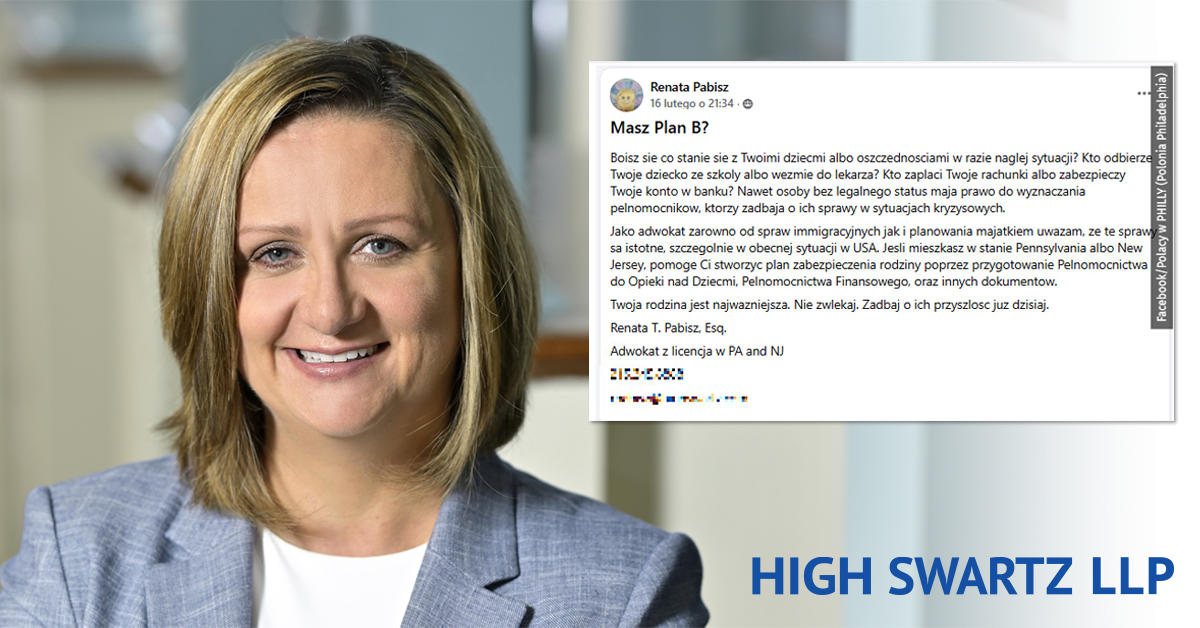
Attorney Renata Pabisz recently asked a timely immigration question on Facebook. A Polish journalist thought her insight should have a bigger audience.
Written from her private social account and posted in Polish American Facebook groups, Renata’s question was simple: It asked, in Polish:
“If you are living here without legal status and ICE shows up tomorrow, do you have a plan B?”
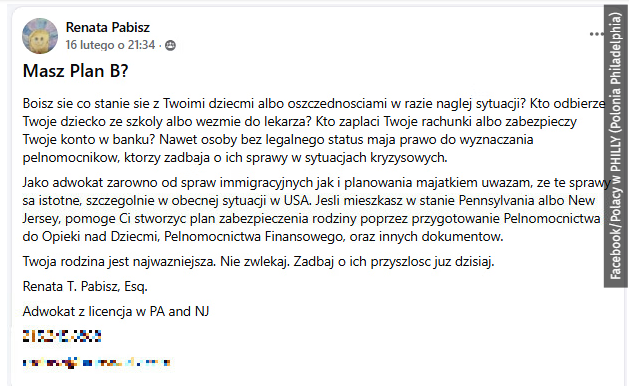
It wasn’t an ad. It was more about informing those that may be questioning their legal standing in today’s environment. It was the kind of practical legal guidance Renata gives her clients every day.
Journalist Tomasz Mateusiak, who writes for Onet.pl, saw the post and recognized the importance of the topic. According to Wikipedia, Onet.pl is one of the largest Polish-language news websites in the world, reaching 42 percent of internet users in Poland every week.
"Right after President Trump began his second term, there was a real panic," Renata told Onet. "I got calls, texts, and emails at all hours. People were afraid they would be deported from one hour to the next, not only from the Polish American community but from people of many nations living currently in the United States."
As of early 2026, DHS reported that over three million people have left the U.S., with more than 675,000 formal deportations and an estimated 2.2 million self-deportations since January 20, 2025.
"I have clients without settled immigration status who run businesses with millions of dollars in assets," she says. "If they are detained, everything they built can collapse overnight. This can be avoided with proper planning."
The resulting article, published March 4, 2026, drew significant readership across Poland and the Polish American community.
The Onet article can be read in Polish here. Translation to English can often be done by right-clicking the page and selecting the Translate option.
The main takeaway from Renata’s insight is this: Immigration laws are always changing. If you are living in the United States without legal status, the time to plan is before a crisis, not after.
The following are some of Renata’s suggestions that families can do now to protect themselves.
What can immigrants do now to protect themselves?
For undocumented immigrants, a durable power of attorney is one of the most important documents they can have. Under Pennsylvania law, a durable power of attorney permits a designated person to act on someone's behalf if they are detained or deported, without delay or court intervention.
A power of attorney, properly drafted by an estate planning attorney, can allow a designated person to access bank accounts, keep a business running, pay employees, fulfill contracts, sell property, and transfer assets to someone who has been deported.
But don’t delay. Waiting until after detention to get these documents in order can create significant complications. Foreign documents may require translation, notarization, an Apostille Certificate, and extended review by American financial institutions before sign off.
And that’s just for business sake. For parents, the stakes go beyond finances.
"It’s very important for parents to have someone they trust with formal authorization," Renata says. "In the worst-case scenario, a trusted relative with power of attorney can care for the child, or even send the child by plane to where their parent was deported."
A formally authorized caregiver can also pick a child up from school, authorize medical care, or assume temporary custody, all without social services involvement.
Are there options outside of deportation?
Not every ICE arrest results in immediate deportation. Most people are entitled to a hearing before an immigration judge.
A cancellation of removal could potentially be granted if the person can generally prove the following:
- Living in the U.S. for ten or more years
- No criminal record
- Good moral character
- Show that deportation would cause significant hardship to a qualified relative of a US citizen or a lawful permanent resident
Children of U.S. citizens over 21 may also be able to sponsor an undocumented parent for permanent residence in certain circumstances.
What about self-deportation?
For people who choose to leave voluntarily, the Trump administration's self-deportation program currently offers qualifying individuals a free flight home and a $2,600 stipend paid upon confirmation of departure. More information is available at dhs.gov/cbphome.
It’s important to consult with an immigration attorney to understand constantly changing immigration law and discuss your options. You can reach attorney Renata Pabisz at High Swartz LLP of suburban Philadelphia at (215) 345-8888 or email her at rpabisz@highswartz.com. Renata is licensed in NJ and PA. As an immigration attorney she practices nationwide and assists clients across the U.S.
About Renata Pabisz, Esq.
Renata is an immigration and estate planning attorney at High Swartz LLP in Doylestown, Pennsylvania. Born and raised near Nowy Sącz, Poland, she earned her law degree from Maria Curie-Skłodowska University before completing her legal education at Widener University School of Law. She has built her practice around helping individuals and families navigate complex immigration and Estate matters in Pennsylvania and beyond.
"Helping people with legal needs is my passion," Renata says. "I couldn't imagine any other career path, even if it meant practicing law in a foreign language."
The information above is for general informational purposes only and does not constitute legal advice. It should not be used as a substitute for consulting with an attorney.
Jak znaleźć polskojęzycznego adwokata w Twojej okolicy
Wiemy, że może być trudno znaleźć osobę, która będzie wspierać i rozumieć to, przez co przechodzisz. W naszej kancelarii zatrudniona jest polskojęzyczna prawniczka Renata T. Pabisz, która potrafi Cię wysłuchać. Mogą również skierować Cię do jednego z naszych prawników i wystąpić w Twoim imieniu.
High Swartz to firma prawnicza oferująca pełen zakres usług, założona w 1914 roku, obsługująca klientów w hrabstwach Montgomery, Bucks, Philadelphia County, Delaware Valley oraz w całej Pensylwanii z biur w Norristown, Doylestown i Wayne w Pensylwanii. Prawnicy High Swartz dokładają wszelkich starań, aby zapewnić swoim klientom doskonałe i opłacalne wsparcie na każdym etapie procesu prawnego.
High Swartz służy potrzebom przedsiębiorstw, gmin, jednostek rządowych, organizacji non-profit, rodzin i osób prywatnych. Ta firma oferująca pełen zakres usług, posiadająca biura w hrabstwach Bucks Delaware i Montgomery, zapewnia kompleksowe porady prawne i wsparcie osobom fizycznym i firmom każdej wielkości z szerokiego spektrum branż w Pensylwanii i stanach środkowoatlantyckich.